What Is Retail Advertising A Simple Guide

Retail advertising is the process for the promotion of products and services from a retail store directly to consumers. The primary goal of this advertising is creating customer interest and desire to drive sales. Modern digital efforts heavily influence the retail sector; reports show 77% of in-store sales are impacted by digital marketing. The growth of retail advertising is significant.
| Metric | Value |
|---|---|
| Market size in 2024 | USD 16.77 billion |
| Projected market size by 2033 | USD 36.53 billion |
| CAGR (2025-2033) | 9.3% |
This expansion involves innovative Esl Retail technology like the Electronic Shelf Labels, ESL Gateway AP, and ESL Price Tag. A successful advertising retail strategy combines retail marketing and advertising to connect a brand with its audience. This makes retail advertising essential for any retail business.
What Are the Core Benefits of Retail Advertising?
Retail advertising offers significant advantages that directly contribute to a business's growth and stability. These strategies are fundamental for generating sales and revenue while building a lasting brand presence. A well-executed advertising plan helps a retail business thrive in a competitive marketplace.
Drive Immediate Sales and Revenue
The primary function of retail advertising is the promotion of products and services to boost immediate financial returns. Campaigns centered on special offers, discounts, or new product launches create urgency. This urgency encourages customers to make purchases, directly impacting a company's bottom line. Effective advertising is a powerful tool for generating sales and revenue.
The return on investment (ROI) can be substantial. For instance, email marketing in the retail sector often shows a high return, with some reports indicating an average of $38 for every dollar spent. The retail and e-commerce industry sees an even more impressive email marketing ROI of 45:1. Furthermore, businesses that combine digital and in-store advertising campaigns have seen a 24% year-on-year increase in ROI, proving the value of an integrated approach to drive sales.
Increase Brand Awareness and Recognition
Consistent advertising builds a strong brand awareness and identity. It takes about 5 to 7 impressions for a consumer to start recognizing a brand's logo. Repeated exposure across various channels makes a brand familiar and memorable to potential customers. This familiarity is crucial because 50% of consumers are more likely to purchase from a brand they already recognize.
Different advertising methods have varying impacts on recall. A study on in-store advertising found that a four-week campaign using shopping cart ads resulted in 68% of shoppers noticing the ad. An impressive 52% of those shoppers could remember the brand without any prompts. This highlights how sustained exposure in a retail environment solidifies brand recognition. Combining digital advertising with traditional methods can further amplify this effect, increasing brand recall by as much as 33% compared to using TV alone.
Key Takeaway: A strong brand awareness and identity, built through consistent advertising, establishes trust and encourages repeat business, giving a retail company a significant competitive edge.
Attract New Customer Segments
Effective advertising retail strategies allow businesses to reach beyond their existing customer base. By analyzing market data, a company can identify and target new demographics. This process involves segmenting potential customers by factors like age, location, or lifestyle. Tailored marketing messages can then be created to appeal directly to these specific groups, creating customer interest and desire.
Several companies have successfully used this approach.
- Coca-Cola and Yummi Gummi both used retail media to grow their market penetration and attract new buyers.
- Brand Collective customized its digital campaigns for segmented audiences, resulting in a 2x increase in new customer acquisition.
- Similarly, Black Diamond improved its customer acquisition by using segmentation, which halved its cost-per-acquisition and doubled its return on ad spend.
This targeted retail marketing approach ensures that advertising efforts are efficient and effective, leading to higher sales and a broader customer base for the retail business.
Build and Maintain Customer Loyalty
Retail advertising extends beyond attracting new faces; it is crucial for nurturing relationships with existing customers. Consistent communication makes customers feel valued and connected to a brand. A retail business can use advertising to share exclusive offers, provide early access to sales, or simply deliver relevant content. This targeted approach reinforces a customer's decision to choose that brand, fostering a sense of loyalty that encourages repeat purchases.
Loyal customers are a retail company's most valuable asset. They tend to spend more and become brand advocates. Effective retail marketing transforms one-time buyers into a loyal community. This strategy ensures long-term stability and growth for the retail business.
Pro Tip: A 5% increase in customer retention can boost a company's profitability by 75%. This shows the immense value of using advertising to maintain loyalty.
Announce Promotions and New Products
One of the most direct benefits of retail advertising is its power in announcing new products and promotions. This form of advertising is essential for informing about special offers and events. It creates excitement and a sense of urgency, driving immediate traffic and sales. A well-timed campaign can turn a new product launch or a seasonal sale into a major success for a retail store.
Modern retail advertising excels at launching new products by using powerful data-driven techniques. This advertising retail approach allows a business to:
- Utilize first-party data: It enables personalized campaigns based on a customer's past purchases and browsing behavior.
- Promote relevant products: This personalization increases the chance of conversion by showing shoppers items that match their needs.
- Consider the consumer journey: Strategic digital ad placement can target consumers late in their decision-making process, converting interest into action.
- Measure data and adapt: Powerful analytics tools allow for real-time tracking, helping businesses adjust their marketing strategy for optimal results.
The timing of advertising is also critical. While publicity may be more effective before a launch, advertising gains the upper hand once the product is available. This makes retail advertising an indispensable tool for post-launch momentum.
| Marketing Method | Timing | Effectiveness Relative to Other Method |
|---|---|---|
| Publicity | Pre-launch | More effective than pre-launch advertising |
| Advertising | Pre-launch | Less effective than pre-launch publicity |
| Advertising | Post-launch | More effective than post-launch publicity |
| Publicity | Post-launch | Less effective than post-launch advertising |
This data highlights how a strategic shift from pre-launch publicity to post-launch advertising can maximize a product's introduction to the market. It ensures that promotional offers and new items reach an engaged audience ready to make a purchase.
Key Types of Modern Retail Advertising
Modern retail advertising encompasses a diverse mix of strategies designed to reach customers wherever they are. A successful approach rarely relies on a single method. Instead, it blends in-store, digital, and traditional tactics into a cohesive campaign. Understanding the different types of retail advertising helps a business choose the right channels to achieve its goals. These methods are broadly categorized into three main groups.
In-Store Advertising Methods
The physical retail space remains a powerful environment for influencing purchase decisions. In-store advertising targets consumers at the point of decision, making it highly effective for driving immediate sales. In fact, 8 out of 10 impulse buys happen in brick-and-mortar stores.
Point-of-Sale (POS) Displays
Point-of-sale displays are promotional materials placed near checkout counters. These displays capitalize on a customer's final moments in the store. They often feature small, high-margin, or impulse-buy items. The effectiveness of this method is significant. Research shows that relocating products to a display near the checkout area can increase sales by an astounding 79.7% to 478%. Nearly 20% of recent in-store impulse purchases were made after a shopper saw a product on display.
Window Displays and Signage
A store's exterior is its first opportunity to make an impression. Creative window displays and clear signage attract foot traffic and communicate the brand's identity. These visual elements can showcase new arrivals, highlight promotions, or create a seasonal theme. Studies confirm that window displays, floor merchandising, and promotional signage positively influence a customer's impulse buying behavior. They create curiosity and draw shoppers inside the retail store.
In-Store Events and Demonstrations
Hosting events or product demonstrations transforms a retail space from a place of transaction into a destination. These activities create memorable experiences that build a community around a brand.
- Product Demonstrations: Allow customers to see a product in action, answering questions and overcoming purchase hesitation.
- Workshops or Classes: Provide value beyond the product, establishing the brand as an expert.
- Exclusive Previews: Make loyal customers feel valued and create buzz around a new launch.
These events directly engage consumers. After hearing an in-store ad or seeing a demonstration, 35% of shoppers purchased the advertised product or a similar one.
Digital Advertising Channels
The digital landscape offers retailers precise targeting and measurement capabilities. Digital advertising spending in the retail sector is projected to grow by 16% next year, a trend driven by major players like Amazon and Walmart establishing their own retail media businesses. This growth highlights the shift toward online engagement.
Social Media Advertising
Social media platforms like Facebook, Instagram, and TikTok allow retailers to reach highly specific audiences. A business can target users based on demographics, interests, and past purchasing behavior. This type of retail advertising is ideal for building brand awareness, promoting flash sales, and driving traffic to e-commerce sites. The visual nature of these platforms makes them perfect for showcasing products in a lifestyle context.
Search Engine Marketing (SEM)
SEM involves placing paid ads on search engines like Google and Bing. This method captures customers with high purchase intent. When a user searches for a specific product, a retailer's ad can appear at the top of the results. This advertising retail strategy is highly effective for driving qualified traffic directly to product pages, leading to higher conversion rates.
Email Marketing Campaigns
Email marketing remains one of the most effective digital channels for retail. It allows for direct communication with customers who have already shown interest in the brand. Retailers use email to announce new products, share exclusive offers, and provide valuable content. This consistent engagement helps build loyalty and drive repeat purchases. The data on conversion rates speaks for itself.
| Channel | B2C Conversion Rate |
|---|---|
| Email Marketing | 2.8% |
| Organic Social | 2.4% |
| SEO | 2.1% |
| Paid Social | 2.1% |
| SEM / PPC | 1.2% |
| Display Ads | 0.7% |
Retail Media Networks
Retail media is a rapidly growing form of digital advertising where brands pay to advertise on a retailer's own website, app, or other digital platforms. This allows brands to reach shoppers directly at the digital point of sale. Because retail media leverages the retailer's first-party customer data, the ads are highly relevant and effective. This is a key strategy for brands looking to stand out on crowded e-commerce marketplaces. The growth of retail media is reshaping the digital advertising ecosystem.
Traditional Advertising Tactics
While digital channels dominate, traditional advertising methods still hold value, especially for reaching local audiences. However, spending reflects a major shift; less than one-fifth (17.1%) of the retail ad budget is now allocated to print and other traditional formats. These types of retail advertising can build trust and reach demographics less active online.
Local Flyers and Circulars
Flyers and newspaper circulars are a classic retail advertising tactic for announcing weekly sales and special promotions. Supermarkets and big-box stores frequently use them to drive foot traffic. They are effective for blanketing a specific geographic area and reaching households that still rely on print media for deals.
Direct Mail Marketing
Direct mail involves sending postcards, catalogs, or letters directly to potential customers' mailboxes. While it can be more expensive than digital methods, a well-designed mailer can cut through digital noise and make a lasting impression. This marketing technique can be targeted by ZIP code or to specific mailing lists, offering a degree of personalization.
Radio and Local TV Spots
Radio and local TV advertising can build brand awareness on a mass scale within a specific region. These channels are excellent for creating an emotional connection through storytelling. However, their influence is waning. Traditional radio advertising, for example, is projected to see a decline in ad spending.
This decline is largely due to listeners, especially younger ones, shifting to on-demand audio platforms and streaming services. The rise of podcasting further fragments the audience, impacting the reach of conventional radio advertising.
The choice between traditional and digital advertising often comes down to goals, budget, and audience. Digital campaigns consistently show a higher return on investment and allow for real-time optimization.
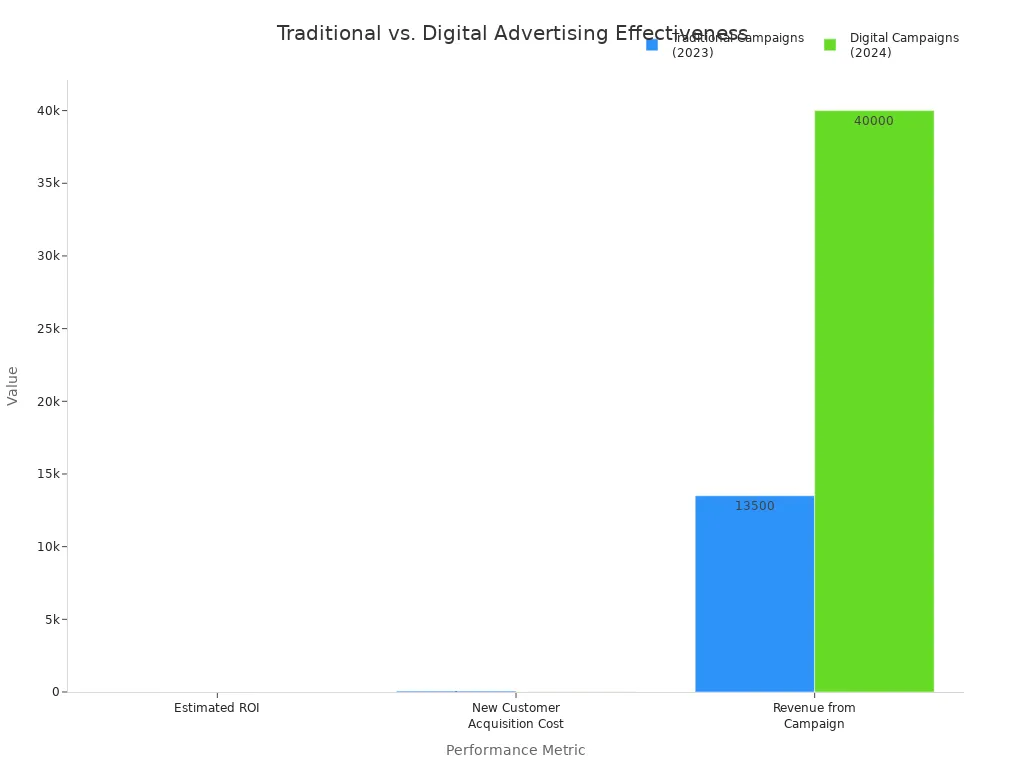
Ultimately, the most effective retail advertising strategy often combines the broad reach of traditional marketing with the precision of digital tools. This integrated approach ensures all types of retail advertising work together to drive sales and build a strong brand.
How to Build a Winning Advertising Retail Strategy
A winning advertising retail strategy is the foundation of sustainable growth. It transforms random promotional activities into a cohesive plan that drives measurable results. Building this strategy involves understanding the customer, setting clear objectives, and selecting the most effective channels to deliver a compelling message. This structured approach helps a retail business navigate the competitive landscape and achieve its long-term goals.
Step 1: Define Your Target Audience
The first and most critical step in any retail advertising campaign is defining the target audience. A business cannot effectively communicate its value without knowing who it is talking to. Creating detailed customer personas is essential. This process involves gathering data to build a semi-fictional representation of the ideal customer.
Retailers can use several methods to collect this information:
- Quantitative Research: Surveys and website analytics, like Google Analytics, provide numerical data on demographics such as age, location, and income.
- Qualitative Research: Interviews and focus groups offer deeper insights into customer attitudes, motivations, and pain points.
- Digital Analytics: Social media analytics tools and customer experience software reveal how potential customers interact with the brand online.
By combining these research methods, a retail business can develop a clear picture of its audience. This understanding allows the company to tailor its advertising messages, product offers, and channel selection to resonate with the people most likely to buy.
Step 2: Set Clear and Measurable Goals
Once the audience is defined, the next step is to set clear and measurable goals. Vague objectives like "increase sales" are not enough. Effective goals are specific, measurable, achievable, relevant, and time-bound (SMART). These goals guide the entire retail advertising strategy and provide a benchmark for success.
Key performance indicators (KPIs) are crucial for tracking progress. Common KPIs for retail advertising include:
- Sales Metrics: Total sales and Return on Ad Spend (ROAS) measure the campaign's direct financial impact.
- Engagement Metrics: Click-Through Rate (CTR) and Conversion Rate show how effectively the advertising captures audience interest and drives action.
- Audience Metrics: Impressions and Reach track how many people saw the ad.
- Cost Metrics: Cost-Per-Click (CPC) and Cost-Per-Thousand Impressions (CPM) monitor advertising efficiency.
Setting specific targets for these KPIs, such as "achieve a 3:1 ROAS within 60 days," gives the marketing team a clear objective to work toward.
Step 3: Choose the Right Advertising Channels
With a defined audience and clear goals, a retail business can choose the right advertising channels. The goal is to select platforms where the target audience is most active. A younger demographic might be more reachable through digital channels like TikTok and Instagram, while other groups may respond better to email marketing or local flyers.
The choice of channel also depends on the campaign's objectives.
- Brand Awareness: Social media advertising and display ads are excellent for reaching a broad audience.
- Driving Conversions: Search Engine Marketing (SEM) and email campaigns with special offers are highly effective for targeting customers ready to purchase.
- Building Loyalty: Content marketing and personalized email offers help nurture existing customer relationships.
A modern retail strategy often blends different channels. Combining the precision of digital advertising with the broad reach of traditional methods can create a powerful, integrated campaign that maximizes impact and drives business growth.
Step 4: Craft a Compelling Message and Offer
With a clear audience and goals, a retail business must craft a message that resonates. This message is the core of the advertising. It should communicate a unique value proposition that answers the customer's question: "Why should I buy from you?" The message must be clear, persuasive, and consistent across all advertising channels. Great retail advertising often combines a powerful message with attractive offers to drive immediate sales.
Successful brands excel at this. Their marketing connects product features to customer needs.
- IKEA targets consumers seeking practical solutions. Its advertising showcases products like storage carts to emphasize affordability and user-friendliness.
- Milani uses in-store ads with before-and-after images for its mascara. The ads highlight a flake-resistant formula and long-lasting wear, proving the product's value in a crowded market.
Amazon Prime provides another strong example. Its value proposition includes free two-day shipping, streaming access, and exclusive discounts. This bundle of benefits appeals to a wide consumer base by offering convenience and value. These compelling offers are central to its business growth. A strong message paired with valuable offers makes any retail advertising campaign more effective.
Step 5: Measure Performance and Optimize
A retail advertising strategy does not end at launch. The final step is a continuous cycle of measuring performance and optimizing for better results. This data-driven approach separates successful campaigns from wasteful spending. A retail company must track the KPIs established in Step 2 to understand what works. This analysis provides the insights needed to refine the advertising strategy over time.
Retailers use various analytics tools to monitor their campaigns. Popular platforms include Google Analytics for website traffic, SEMrush for SEO and competitor insights, and Hotjar for understanding user behavior through heatmaps. Modern AI-powered tools like Madgicx offer even deeper analytics for e-commerce, helping to automate optimization and improve attribution. Using these digital tools is essential for profitable campaigns.
The best analytics strategies are customized to a business's specific data and customers. Making data-driven decisions and accurately crediting different platforms are crucial for smart budget allocation. This process turns guesswork into a predictable system for growth.
By consistently analyzing performance data, a retail business can adjust its messaging, shift its budget to better-performing channels, and refine its offers. This optimization process ensures the marketing investment generates the highest possible return.
Setting a Realistic Budget for Your Campaigns
An excellent retail advertising strategy requires a well-planned budget. Setting a realistic budget ensures that a retail business can fund its campaigns effectively without overspending. It involves choosing a method that aligns with the company's financial situation and strategic goals. Three common approaches help retailers determine how much to allocate to their advertising efforts.
The Percentage of Sales Method
The percentage of sales method is a straightforward approach to budgeting. A retail business allocates a fixed percentage of its past or projected sales revenue to advertising. This method is simple to implement and provides a clear, predictable budget.
- Simplicity and Consistency: This technique is easy to calculate. A company just needs its sales revenue and a set percentage based on historical data or industry benchmarks. This consistency makes planning and adjustments across different periods easier.
- Responsiveness: The budget naturally adjusts with sales fluctuations. If sales increase, the advertising budget grows. If sales decline, the budget shrinks, which can help protect profit margins.
- Inaccuracy and Rigidity: A major drawback is its assumption that all expenses are proportional to sales. Fixed costs like rent or salaries do not change with sales, which can lead to inaccurate budgets. This method can also discourage innovation, as it relies on past performance rather than future goals. A declining sales trend would force continuous cuts to the marketing budget, even if the decline is unrelated to advertising effectiveness.
Competitor-Based Budgeting
Competitor-based budgeting involves setting an advertising budget based on what competitors are spending. This method helps a retail company maintain a competitive share of voice in the market. By monitoring rivals, a business can ensure it is not being outspent and can identify new opportunities.
Modern tools provide deep insights into competitor strategies. Aura Cruceru, a Performance Marketing Team Lead at Semrush, notes the game-changing impact of this data, especially in the retail sector where leaders like Amazon spend millions monthly. Using platforms like AdClarity, retailers can analyze:
- A competitor's total ad spend and channel allocation.
- The creative messaging that performs well for them.
- Their performance on key marketplaces like Amazon.
- How they utilize emerging channels like CTV and Native Ads.
This intelligence allows a business to benchmark its own spending and optimize its media mix. It turns competitor analysis into a strategic advantage for planning future advertising campaigns.
The Objective and Task Method
The objective and task method is the most strategic approach to budgeting. It aligns spending directly with specific marketing goals. Instead of starting with a sales percentage or competitor spending, this method begins by defining what the retail advertising campaign needs to achieve.
The process involves several key steps:
- Set Clear Objectives: Leaders first agree on strategic goals, such as increasing market share by 10% or launching a new product line.
- Identify Necessary Tasks: The team then outlines all the tasks required to meet these objectives. This could include running a social media campaign, creating in-store displays, and investing in search engine advertising.
- Estimate Costs: Finally, the business estimates the cost of each task. The sum of these costs becomes the total advertising budget.
This method requires detailed planning and forecasting. A company must review historical data, forecast sales, and estimate all associated costs to create a comprehensive budget. The final step involves creating a budgeted profit and loss statement and a cash flow plan to ensure financial viability. This goal-oriented approach ensures every dollar spent on advertising has a clear purpose, connecting the budget directly to business growth.
Allocating Your Budget Across Channels
Once a budget is set, a retail business must decide where to invest it. Allocating funds across different advertising channels is a critical decision that directly impacts campaign success. A balanced approach ensures the marketing budget works efficiently to reach customers at various stages of their buying journey. The goal is to create an optimal media mix that maximizes return on investment.
A popular and effective framework for budget allocation is the 70/20/10 rule. This model provides a structured yet flexible guide for spending.
- 70% on Proven Tactics: A business should allocate the majority of its budget to channels that consistently deliver results. This includes core strategies like search engine advertising or email marketing with a history of strong performance.
- 20% on Innovative Strategies: This portion funds emerging channels or new platforms where the target audience is growing. It allows a retail company to expand its reach without risking the entire budget.
- 10% on Experimental Initiatives: The final 10% is for testing completely new and unproven advertising ideas. These high-risk experiments can lead to breakthrough discoveries.
Choosing the right mix requires a deep understanding of the customer. Global spending on digital advertising surpassed $500 billion in 2021, but this does not make traditional methods obsolete. Studies show people are nearly 70% more likely to remember a business from a physical mailer than a digital ad. Direct mail also has an average response rate of 9%, outperforming many digital channels. This data highlights the power of an integrated retail advertising strategy that blends digital precision with the tangible impact of traditional media.
To allocate funds effectively, a retail business must use a data-driven process. This involves auditing current marketing practices, calculating lead-to-conversion rates, and determining how many leads are needed to hit sales targets. Advanced retailers also use multi-touch attribution (MTA) and media mix modeling (MMM) to measure the true impact of each channel and identify points of diminishing returns. This continuous cycle of analysis and adjustment turns budget allocation from guesswork into a science.
Effective Examples of Retail Advertising in Action
Understanding retail advertising theory is one thing; seeing it work in the real world provides clarity. These examples show how different retail businesses use specific advertising tactics to achieve their goals, from driving foot traffic to building digital loyalty. Each strategy is tailored to the business type and its target customer.
The Local Supermarket's Weekly Flyer
The weekly flyer is a classic form of retail advertising that remains highly effective for supermarkets. This printed circular is a primary tool for informing about special offers and events. It directly targets local households with promotions on groceries, produce, and household goods. The main goal is to drive in-store traffic and boost weekly sales by creating a sense of urgency around limited-time deals. This traditional advertising method builds a routine for shoppers who rely on it to plan their weekly shopping and save money.
The Boutique's Targeted Facebook Ads
A fashion boutique can leverage digital advertising to reach a niche audience with precision. Targeted Facebook ads allow the retail business to connect with potential customers based on interests, demographics, and online behavior. This marketing approach is perfect for showcasing new collections or promoting exclusive sales. The success of this retail advertising is not just about clicks; it is measured by concrete financial outcomes.
Key metrics help the retail store gauge the effectiveness of its advertising spend. By tracking these indicators, a business can optimize its campaigns for maximum profitability.
- Return on Ad Spend (ROAS): This measures the total revenue generated for every dollar spent on advertising.
- Cost per Conversion (CPA): This shows how much it costs to acquire a paying customer, indicating campaign efficiency.
- Add-to-Cart Rate: This mid-funnel metric reveals how many users show strong purchase intent, helping to refine ad creative and targeting.
The Coffee Shop's Loyalty App Offer
Modern coffee shops use mobile apps to turn one-time visitors into loyal regulars. A loyalty app is a powerful channel for direct-to-consumer advertising. It uses personalized offers to encourage repeat business. For example, a digital punch card, where a customer gets a free coffee after a certain number of purchases, provides a clear incentive to return. This strategy is effective because 75% of consumers are more likely to make another purchase after receiving a reward.
These apps often include tiered programs that unlock exclusive perks as customers spend more. This gamified approach fosters a sense of community and encourages higher spending per visit. By sending personalized offers and celebrating customer milestones like birthdays, the retail shop strengthens its relationship with its patrons, boosting both visit frequency and average order size.
The Electronics Store's Google Shopping Ads
Electronics stores thrive in the competitive digital marketplace by using Google Shopping ads. This form of retail advertising is highly effective for capturing customers who are actively searching for specific products. These visual ads appear at the top of Google search results, showcasing a product's image, price, and the retailer's name. This immediate presentation of key information helps a retail business stand out when a consumer is ready to make a purchase decision. The visual format is perfect for tech gadgets, where appearance and model numbers are critical.
The process behind this advertising is straightforward. A retail store uploads its product inventory to Google Merchant Center. When a shopper searches for an item like a "4K television" or "wireless headphones," Google's algorithm pulls relevant products from this feed and displays them in a carousel. This allows consumers to compare different offers quickly without clicking through multiple websites. This powerful marketing tool connects motivated buyers directly with the products they want to buy.
For the electronics retail sector, the return on this type of advertising is significant. These campaigns target users with high purchase intent, leading to strong conversion rates. The financial performance data for this vertical highlights its effectiveness. A well-managed campaign can generate substantial revenue relative to its cost, making it a cornerstone of a modern digital strategy. The following table shows the average return on ad spend (ROAS) for the industry.
| Vertical | ROAS |
|---|---|
| Computer & Electronics | 5.99 |
This data indicates that for every dollar spent on this advertising, an electronics store can expect to generate nearly six dollars in revenue. To achieve such results, a business must optimize its product feed with high-quality images, accurate pricing, and compelling titles. Running promotions and highlighting special offers within the ads can further increase their appeal. Ultimately, Google Shopping ads provide a direct and profitable channel for electronics retailers to drive online sales and compete effectively.
Common Mistakes to Avoid in Your Campaigns
Even a well-funded retail advertising campaign can fail without careful planning. Certain common pitfalls can undermine an entire strategy, leading to wasted resources and poor results. A retail business can protect its investment and improve its chances of success by understanding and avoiding these errors. Effective advertising requires more than just a budget; it demands strategic execution.
Neglecting Your Target Audience
The most significant mistake in retail is creating advertising without a clear audience in mind. When a business does not know who it is talking to, its message becomes generic and ineffective. This oversight leads to several problems.
- Wasted ad spend on uninterested people.
- Low engagement rates and poor conversions.
- A disconnect between the product and the consumer.
A successful campaign speaks directly to the needs and desires of a specific customer segment. Ignoring this fundamental step ensures the advertising will not resonate, making it impossible to achieve meaningful goals. Every decision, from channel selection to messaging, should start with the target customer.
Using an Inconsistent or Unclear Message
Customers build trust with brands that are consistent. A common error is using conflicting messages, tones, or visuals across different advertising channels. One campaign might promote a retail brand as a luxury option, while another presents it as a budget-friendly choice. This inconsistency confuses potential buyers and weakens brand identity.
A clear, unified message is the backbone of brand recognition. It ensures that whether a customer sees an ad on social media or in a local flyer, they receive the same core value proposition.
An unclear message is just as damaging. If a customer cannot quickly understand what a business is offering or why it matters, they will simply move on. Every piece of advertising must communicate its purpose with clarity and conviction.
Forgetting a Strong Call-to-Action (CTA)
Great advertising captures attention, but it must also guide the customer toward a specific action. A frequent mistake is failing to include a strong, clear call-to-action. The CTA tells the audience exactly what to do next. Without it, a potential customer may feel interested but will not know how to proceed.
Effective CTAs are direct and create a sense of urgency. Examples include:
Shop Now and Save 20%Visit Our Store TodayDownload Our App for Exclusive Offers
Every ad, from a digital banner to a radio spot, should end with a compelling instruction. This simple element is often the final push a consumer needs to move from passive viewer to active customer for the retail business.
Failing to Track and Analyze Results
Launching an advertising campaign without tracking its performance is a costly error. A retail business that does not measure results is essentially guessing about its marketing effectiveness. This approach makes it impossible to determine the return on investment (ROI). It also prevents the company from learning which messages, offers, and channels perform best. Effective retail advertising relies on a continuous cycle of testing, measuring, and optimizing.
Data is the compass for your advertising strategy. Without it, you are navigating blind, wasting your budget on efforts that may not be contributing to business growth.
Tracking key performance indicators (KPIs) provides actionable insights. This data shows what is working and what is not. A retail company can then reallocate its budget to the most profitable activities. This data-driven process transforms advertising from an expense into a predictable driver of revenue. Failing to analyze results means repeating the same mistakes and missing opportunities for growth.
Ignoring the Mobile Customer Experience
In today's market, overlooking the mobile customer is a critical failure. The majority of consumers now use their smartphones to browse and shop. A poor mobile experience can erase the impact of even the most brilliant advertising campaign. If a customer clicks an ad and lands on a slow or confusing website, they will likely leave immediately. This is a significant issue for any retail brand.
The data on mobile commerce highlights its importance. A seamless mobile journey is no longer optional; it is essential for conversion.
- Mobile devices account for up to 75% of all retail website traffic.
- However, mobile cart abandonment rates are extremely high, reaching nearly 86% in some studies.
- A complicated checkout process is a major reason for this, causing around 20% of shoppers to abandon their purchase.
These statistics show a clear disconnect. While customers prefer to browse on mobile, many retail sites are not optimized to convert them. A successful digital strategy must prioritize a fast, intuitive mobile interface. This ensures the investment in advertising translates into sales rather than frustrated users and lost revenue.
Retail advertising provides a direct line of communication between a retail business and its customers. Success in this area requires a strategic mix of advertising methods. This blend includes in-store, digital, and traditional tactics tailored to a specific audience.
By setting clear goals, crafting compelling messages, and measuring results, a retail company can use its advertising to effectively drive sales and grow its brand.
FAQ
What is the main purpose of retail advertising?
The main purpose of retail advertising is creating customer interest and desire for a store's products. This process is a key driver for generating sales and revenue. It directly connects a retail business with potential buyers through targeted promotional messages.
How does retail marketing differ from retail advertising?
Retail marketing is the broad strategy for promoting a store, including pricing and placement. Retail advertising is a specific part of that strategy. It involves paid promotional activities designed to reach customers and communicate specific offers.
What are the main types of retail advertising?
The primary types of retail advertising fall into three categories.
- Digital: Social media ads and search engine marketing.
- In-Store: Point-of-sale displays and window signage.
- Traditional: Local flyers and radio spots.
A successful strategy often blends these methods.
Why is digital advertising important for retail?
Digital advertising is vital because it allows a retail business to target specific customer groups with precision. This efficiency helps increase online traffic and improve conversion rates, leading to higher sales. It provides measurable data to optimize campaigns for better performance.
What is retail media?
Retail media is a growing form of digital advertising. It involves brands paying to place ads on a retailer's website, app, or other digital platforms. This marketing tactic allows brands to reach shoppers directly at the digital point of sale.
How does advertising support the promotion of products and services?
Advertising is essential for the promotion of products and services. It works by informing about special offers and events. Consistent campaigns also build brand awareness and identity, which establishes trust and encourages customers to make a purchase.
What does the term advertising retail mean?
The term advertising retail describes the complete process of promoting a retail store and its inventory. It encompasses all marketing and advertising activities a business uses to connect with its audience, drive traffic, and increase sales.
See Also
Navigating The Digital Abyss: Understanding The Mysterious 404 Error