Electronic Price Tags The Real Cost for Your Store
You see electronic price tags as a significant investment for your store in 2025. The global market for electronic shelf labels is projected to exceed USD 1.6 billion, showing massive industry adoption. The real cost involves more than just the ESL Price Tag; it includes the ESL Gateway AP and software. However, the total ownership cost for electronic labels has fallen significantly.
This trend makes them a financially smart choice for the modern Esl Retail environment, promising significant long-term savings and operational efficiency.
Breaking Down the Upfront Investment in 2025

Understanding the initial investment is the first step toward evaluating electronic price tags. You must look beyond the tag itself to see the full picture. The total upfront cost includes the hardware, the supporting infrastructure, and the software that powers the entire system.
Cost Per Tag: What to Expect
The price per tag is the most visible part of your investment. In 2025, this cost varies based on size, display technology, and features. You can find a wide range of options to fit your specific needs and budget.
- Basic Models: These smaller, simpler displays typically range from $5 to $10 per unit. They are perfect for displaying essential product names and prices on standard shelves.
- Advanced Models: Larger digital price labels with full-color graphics or promotional capabilities can cost anywhere from $15 to over $50. Some large, specialized promotional labels can even exceed $100.
- Feature-Rich Options: Adding features like multi-color LED lights or NFC for customer interaction will increase the unit price. For example, a popular full-graphic e-paper tag like the Newton M3 2.2” often falls in the $8-$10 range.
Pro Tip: Don't forget the power of bulk purchasing. When you outfit an entire store, you are buying thousands of units. Suppliers often provide significant volume discounts. A large order of 10,000 or more electronic labels can reduce the per-unit price by over 10%, making a large-scale rollout more financially manageable.
Infrastructure: The Hidden Expenses
Your new digital tags need a network to communicate. This requires installing dedicated hardware, which represents a crucial, and sometimes overlooked, expense.
The primary components are gateways or access points. These devices connect your central pricing system to the tags on the shelf, transmitting data wirelessly. The number of gateways you need depends on your store's size and layout. For a typical 1,000-square-meter (approx. 10,700 sq. ft.) retail space, you might need three to four gateways. With each unit costing between $300 and $400, you can estimate an infrastructure hardware cost of around $1,200 for a store of this size.
Overall, you should budget between $1,000 and $10,000 for total installation and infrastructure setup. This range accounts for hardware, wiring, and professional installation, which can vary based on your store's unique architecture and existing systems.
Software and Integration Fees
Software is the brain of your ESL system. It allows you to manage prices, promotions, and product data from a central dashboard. The licensing model for this software directly impacts your initial investment.
A common model you will encounter is the Embedded Software License (ESL). This is often the most affordable way to acquire powerful software.
With an ESL model, the software is deeply integrated into the hardware or a third-party application. It is designed for a specific function—running your pricing system—and cannot be used for other purposes. This restriction is why it is the least expensive option, with discounts potentially reaching up to 90% compared to a standard license. You get all the necessary functionality without paying for features you don't need.
You must also account for one-time integration fees. These fees cover the professional services required to connect the ESL software with your existing systems, such as your Point of Sale (POS) or Enterprise Resource Planning (ERP) software. This ensures seamless data flow and automates your pricing updates.
How Electronic Price Tags Reduce Operational Costs
While the initial purchase requires a budget, the true financial power of electronic price tags is revealed in your daily operations. You unlock significant savings by automating outdated, manual processes. This shift directly reduces your operational cost and boosts your bottom line.
Eliminate Labor for Price Changes
You can reclaim countless hours your staff currently spends on manual price updates. Instead of walking the aisles with a label gun, your team can focus on high-value tasks like customer service and inventory management. Consider the impact on a typical store:
- A supermarket can save approximately 50 labor hours every week.
- Automating updates saves up to 12 hours per week per store.
- A store with 10,000 products can save over 8 hours weekly just by automating price changes.
This recovered time translates directly into lower labor expenses and a more productive, customer-focused workforce.
Cut Material and Consumable Spending
You eliminate the recurring expenses of paper, ink, toner, and printers. Traditional paper labels create a constant cycle of resource consumption and waste. Electronic labels offer a more sustainable and cost-effective alternative.
Electronic shelf labels use energy-saving technology, featuring low-energy e-ink displays that consume minimal power. This makes them an efficient solution that helps reduce your store's overall energy consumption and electricity bills.
With batteries lasting 5 to 10 years, you drastically reduce paper waste and your store's carbon footprint, aligning your brand with modern sustainability efforts.
Minimize Costly Pricing Errors
Manual pricing is prone to human error, leading to mismatches between the shelf and the checkout scanner. These mistakes can damage customer trust and cause significant revenue loss—in some cases, incorrect data entry can cost a business up to 30% of its revenue. Centralized digital control ensures 100% accuracy.
Retailers who make the switch see immediate and dramatic improvements.
| Retailer Type / System | Pricing Error Reduction |
|---|---|
| U.S. Grocers (with ESLs) | 50–80% fewer pricing mismatches |
| GreenMart (AI-powered ESLs) | 99% error reduction |
This level of accuracy protects your profit margins on every single transaction and prevents the customer complaints that arise from price discrepancies.
Calculating the ROI of Your Digital Shelf Labels
After understanding the upfront costs and operational savings, you can now calculate the return on investment (ROI). This calculation shows you exactly how and when your investment in digital shelf labels will pay for itself and start generating profit. A positive ROI confirms that the financial benefits outweigh the initial and ongoing expenses.
The Simple ROI Formula for ESLs
You can determine your potential return with a straightforward formula. This calculation gives you a clear percentage that represents the profitability of your investment.
The Formula:
ROI = (Total Return – Total Investment) / Total Investment × 100%
To use this formula effectively, you must gather accurate data. Follow these steps to build a reliable financial projection:
- Estimate Current Operational Costs. You need a clear baseline. Collect data on your current expenses for paper-based labeling. This includes labor hours for price changes, printing supplies (paper, ink), and time spent correcting errors.
- Project Future Savings and Revenue. You can now estimate the financial gains from your new system. Factor in reduced labor, eliminated material costs, and the revenue saved by preventing pricing errors. You should also project potential revenue increases from new capabilities like dynamic pricing.
Your total investment, or Total Cost of Ownership (TCO), includes more than just the hardware. You must account for all related expenses over the system's lifecycle.
- Acquisition Costs: This covers the direct cost of the digital price labels, gateways, mounting hardware, and initial installation services.
- Operating Costs: These are ongoing expenses like software licensing fees, network monitoring, and potential technical support contracts.
- End-of-Life Costs: You should also consider future expenses for battery replacements (typically every 5-10 years) and the responsible disposal or recycling of old units.
Typical ROI Timelines in 2025
The time it takes to recoup your investment varies based on your store's size, complexity, and operational model. However, in 2025, payback periods are faster than ever. Larger stores with more frequent price changes often see the quickest returns.
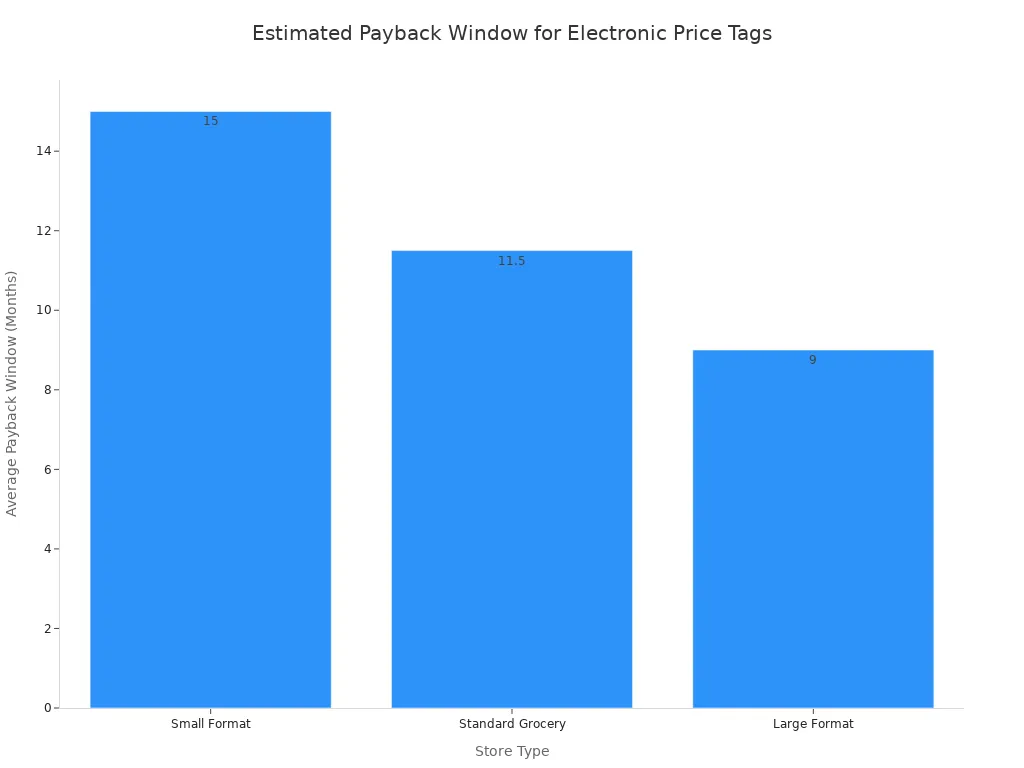
Here is a breakdown of typical payback windows you can expect:
| Store Type | Key Assumptions | Estimated Payback Window | Top Savings Driver |
|---|---|---|---|
| Small Format | 500–1,000 SKUs, daily updates | 12–18 months | Labor reduction |
| Standard Grocery | 15,000–25,000 SKUs, 3x/week updates | 8–15 months | Error + labor reduction |
| Large Format | 50,000+ SKUs, dynamic pricing | 6–12 months | Operational efficiency |
Several factors can accelerate or delay your ROI. Choosing a subscription model (Opex) over an outright purchase (Capex) can spread out costs. Starting with a pilot program allows you to test the system and scale your investment over time. Selecting a platform that integrates cleanly with your existing POS and ERP systems also prevents costly custom IT work, helping you stay on budget and achieve a faster return.
Intangible Benefits That Boost Profit
Beyond direct cost savings, electronic shelf labels deliver powerful intangible benefits that directly contribute to your bottom line. These advantages enhance customer experience and unlock new revenue opportunities.
Build Customer Trust and Loyalty 🤝 Pricing errors destroy customer confidence. When a price on the shelf doesn't match the price at checkout, it creates friction and frustration. Digital shelf labels ensure 100% accuracy, creating a seamless and trustworthy shopping experience. This consistency strengthens your brand's reputation, as customers learn they can rely on your pricing. Furthermore, by automating label changes, you free up staff to focus on what matters most: assisting customers. This improved service makes shoppers feel valued and encourages loyalty.
Unlock New Revenue with Dynamic Pricing 📈 Dynamic pricing is one of the most powerful capabilities unlocked by this technology. It allows you to adjust prices instantly across thousands of items in response to market conditions.
- Reduce Waste: For perishable goods, you can implement automated markdowns as expiration dates approach. This strategy minimizes waste and recovers revenue from items that would otherwise be a total loss.
- Optimize Margins: You can use price optimization software to strategically adjust prices. This allows you to maintain higher margins on less price-sensitive items, like private-label goods or specialty products, while remaining competitive on key value items.
- Create In-Store Advertising: Your digital shelf labels can become a new revenue stream. You can sell advertising space to brands, allowing them to display promotions directly at the point of decision. This creates a retail media network right on your shelves.
By embracing these advanced strategies, you transform your pricing from a static necessity into a dynamic tool for maximizing profitability.
Why Invest Now? Market Trends in 2025
Deciding when to invest is as important as what you invest in. In 2025, the market for electronic shelf labels is not just growing; it is accelerating. Delaying your adoption means falling behind competitors who are already leveraging this technology to build more efficient and profitable businesses.
Growing Market and Adoption Rates
You are not alone in considering this upgrade. The retail industry is rapidly adopting ESLs, with hypermarkets and supermarkets leading the charge. These large-format stores recognize the immense value in operational efficiency. Non-food retail is also experiencing explosive growth in adoption.
This widespread adoption signals a fundamental shift in retail operations. Early adopters are setting a new standard for efficiency and customer experience that will soon become the baseline expectation.
| Retail Segment | Market Share (2022) | CAGR (Forecast Period) |
|---|---|---|
| Hypermarkets & Supermarkets | 35.0% | Dominant |
| Non-Food Retail Stores | N/A | 20.0% |
Boosting Efficiency, Not Just Prices
ESLs do more than just display an accurate price; they are a cornerstone of a smarter, more efficient inventory management system. By integrating with your central database, you gain a real-time view of your stock levels. This connectivity transforms how you manage inventory.
- Achieve High Accuracy: Item-level tagging provides an immediate and precise inventory count, with studies showing accuracy improvements between 63% and 95%.
- Prevent Stockouts: Real-time data helps you maintain optimum stock levels, ensuring you can fulfill orders and avoid lost sales from out-of-stock items.
- Automate Monitoring: Systems can use sensors and machine learning to automatically detect low stock, misplaced products, and replenishment needs, guiding your staff directly to the issue.
Gaining a Competitive Edge
In a crowded market, you need to offer a superior shopping experience. Electronic shelf labels provide a platform for innovation that sets your store apart. You can move beyond static labels and create a dynamic, interactive environment.
- Create In-Store Buzz: Use blinking 7-color LEDs to draw attention to promotions, new arrivals, or discounted items.
- Modernize the Checkout: Implement NFC-enabled tags to allow tech-savvy shoppers to complete cashless transactions directly at the shelf.
- Enhance Customer Service: Program buttons on the labels to let shoppers alert staff for assistance, improving service without adding payroll.
By adopting this technology now, you position your store as a modern, efficient, and customer-focused leader.
While the initial outlay for electronic price tags is notable, you unlock dramatic operational savings that make them a cost-effective investment in 2025. The true cost of inaction—continuing with an inefficient paper system—often outweighs the investment.
Retailers report achieving breakeven in just 9-15 months, with some projecting a tenfold return over the system's lifespan.
For modern retailers, electronic price tags are a strategic tool for efficiency, accuracy, and long-term profitability.
FAQ
How long do electronic price tags last?
You can expect your electronic price tags to have a long operational life. The hardware is durable for a retail environment. The e-paper displays consume very little power, allowing the batteries to last between 5 and 10 years before you need to consider replacements.
Are ESLs a good fit for a small store?
Yes, ESLs offer significant value to small stores. You gain major labor savings and eliminate costly pricing errors. While the initial investment is a factor, the operational efficiencies often provide a clear return on investment within 12 to 18 months, making it a smart long-term decision.
How secure is the pricing data?
Your pricing data remains highly secure. ESL systems transmit information using proprietary, encrypted wireless protocols. This secure communication prevents outside interference or unauthorized price changes, ensuring the data you send from your central system is exactly what appears on the shelf.
What happens if a tag breaks or the battery dies?
Your central software dashboard monitors the health of every tag. It will alert you if a tag has a low battery or stops communicating. This allows you to quickly identify and replace any non-functional units, ensuring your shelves always display accurate, up-to-date information.